


Commercial Security: The Right Safe for Cash Handling and Business Assets
Tax season has a way of focusing the mind on financial accountability. April means reconciling receipts, pulling cash records, and sometimes realizing that your business's money has been moving through a system that relies more on trust than actual security. For any business that handles cash daily, whether you're running a restaurant, a convenience store, a salon, or a multi-location retail operation, a well-chosen depository safe is one of the most cost-effective investments you can make.
This isn't just about protecting against outside theft. The data on internal theft might surprise you, and the right safe solves both problems at once.
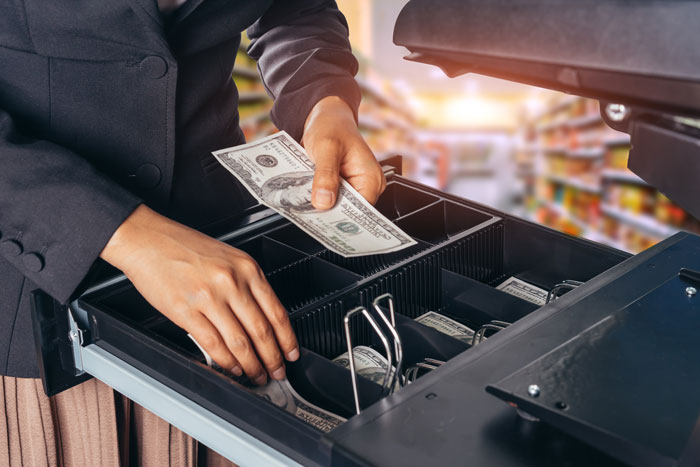
Any business running a cash register every day is a candidate for a depository safe. Photo: Unsplash
Why Cash Security Is a Year-Round Business Problem
Most small business owners think of cash security as a burglary problem. Someone breaks in after hours, gets into your till or back-office safe, and you file an insurance claim. That scenario is real, but it accounts for a relatively small share of business cash losses.
According to the Association of Certified Fraud Examiners, small businesses lose roughly 5% of annual revenue to occupational fraud each year. For a restaurant doing $1 million in sales, that's $50,000 walking out the door annually, often in small amounts that never trigger alarm bells individually. Cash businesses are especially exposed because cash doesn't leave a paper trail on its own.
The right safe doesn't just protect your money from intruders. It creates a system around your cash that makes both external theft and internal theft significantly harder to pull off undetected.
How Depository Safes Actually Work
A depository safe, also called a drop safe or cash management safe, is designed around one core idea: money goes in, but only authorized people can get it out. The deposit mechanism is separate from the main compartment. Employees can drop cash, checks, and receipts through a slot or hopper without ever accessing the stored funds inside.
The most common deposit mechanisms are:
- Front-load drop doors: A small hinged door on the front of the safe opens to a chute that drops deposits into the main compartment. Compact and easy to install under a counter.
- Rotary hoppers: A cylindrical chamber in the top of the safe rotates when you insert cash, depositing it inside while preventing retrieval. Common in high-volume retail.
- Pull-out drawer mechanisms: A spring-loaded drawer sits behind the drop slot. Deposits fall into the drawer, which is separate from the main vault compartment. Useful when you need to access drop contents without opening the full safe.
All quality depository safes include anti-fish baffles, which are jagged teeth or baffles inside the deposit chute designed to prevent someone from threading a wire or hook back through the slot to retrieve what's been dropped. On cheaper safes, this feature is often absent or poorly implemented. It's one of the first things to verify when evaluating a unit.

Cash handled daily in a business setting needs a secure, accountable system from register to pickup. Photo: Unsplash
Internal Theft: The Risk Most Owners Underestimate
The single biggest advantage of a well-implemented depository safe system isn't external security. It's friction. When employees know that cash goes directly into a locked safe and the count is verified at pickup, the opportunity for skimming narrows dramatically.
Skimming, where an employee removes cash before it's recorded, is the most common form of small business fraud. It often happens at the point of sale or during end-of-shift drawer counts. A drop safe system interrupts both opportunities. Cash goes from the register into the safe, and the only person who can retrieve it is a manager or the armored car service. The system creates accountability without requiring surveillance of every transaction.
Dual-compartment safes take this further by separating daily deposits from a reserve or change fund. A cashier can access the change fund compartment with one code while the deposit compartment requires a manager's code. Neither party can access both compartments with a single credential. That separation is a meaningful structural control that costs nothing extra to operate once it's in place.
Audit Trails and Electronic Locks
The most sophisticated business safes go further than dual codes. ESL Audit locks, like the ESLAUDIT II found on AMSEC's commercial cash management line, log every access event with a timestamp and user code. You can pull a report showing exactly who opened the safe, when, and how many times, without any video system or additional software.
For multi-location operations, this is a significant tool. Managers can review access logs, identify anomalies in after-hours openings, and create a documented chain of custody for cash from register to pickup. Insurance underwriters also respond well to audit trail documentation when evaluating commercial policy terms.
Watch It In Action
Not sure how a front-load drop safe actually works day-to-day? This short video from the Dean Safe team walks through the deposit mechanism, anti-fish baffle, and overall construction of a Stealth drop safe, the same American-made series featured in the product recommendations below.
What to Look for When Buying a Business Safe
Before you start comparing models, answer a few questions about how your business actually operates. How many drops happen per shift? Do multiple employees have deposit access, or just one? Is the safe going under a counter, in a back office, or in a vault room? Do you use an armored car service for cash pickups?
- Single location, low drop volume: A front-load drop safe in the 14 to 20-inch width range is typically sufficient. Look for a UL-listed electronic lock and a B-rate body. The Hollon FD-2014E and Stealth DS2014 are both solid here.
- Multiple employees making drops: Choose a unit with a programmable electronic lock that supports multiple user codes, or an audit-capable lock if you want access logging. The AMSEC DSF2014 with ESL10XL lock includes a built-in time delay function, which is useful for armored car environments.
- Tech-forward operation wanting biometric access: The Barska AX13108 adds fingerprint recognition to the standard keypad, letting you log in by touch for fast, key-free access during rush hours.
- High-volume retail or restaurant, large footprint: The Stealth DS3020FL12 steps up to a 30" tall wide-body format with an internal locker compartment for separating change fund from daily deposits, making it purpose-built for multi-shift operations.
- Armored car pickup: Confirm the safe's dimensions work with your carrier's procedures. Some carriers require specific drop mechanisms or compartment configurations.
Recommended Commercial Safes at Dean Safe
We carry a wide selection of commercial depository safes across every price point and use case. Here are five models that cover the range from entry-level to heavy-duty commercial environments.


